


South Africa - Life World Library
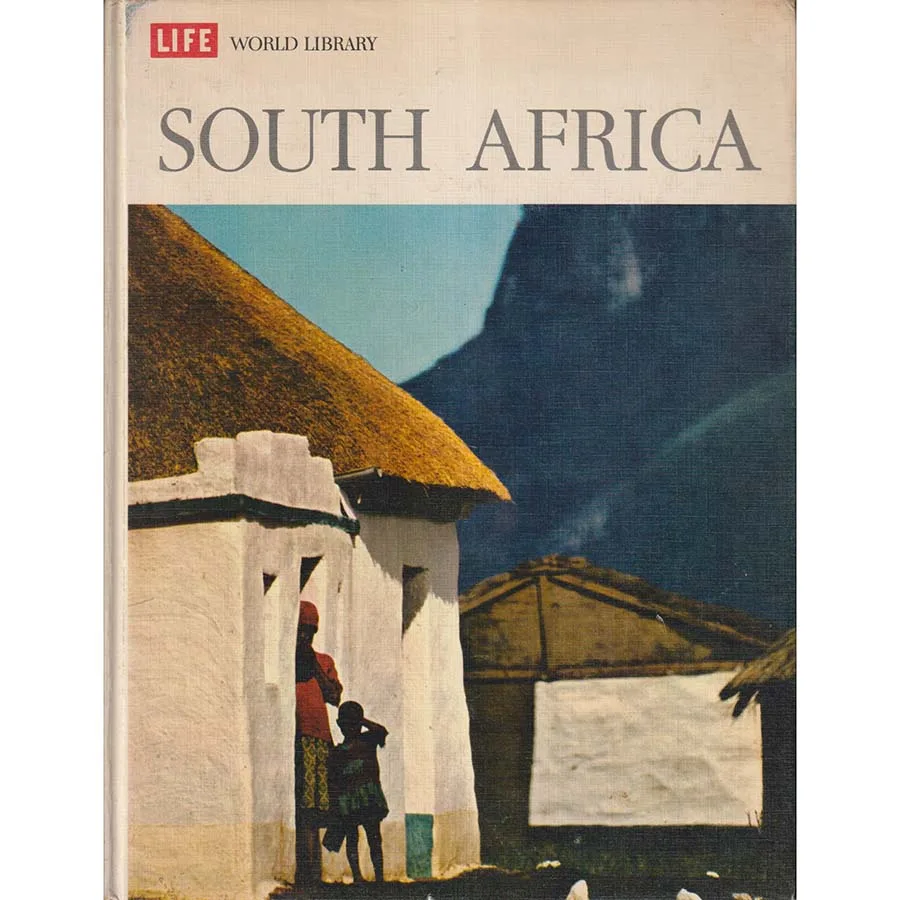
Publisher: Time-Life International
Format: Hardback
ISBN: none
South Africa - Life World Library (1965) by Tom Hopkinson – Time-Life International
ISBN: None
Condition: Good
South Africa, 1965. A country of extraordinary landscapes, enormous mineral wealth, rapidly growing cities, complicated history and a political system so morally indefensible that even the most polished mid-century reference book could not make it disappear behind photographs of mountains.
Published by Time-Life International as part of its ambitious Life World Library series, South Africa was written by distinguished British journalist and editor Tom Hopkinson. Like the other volumes in the series, it sets out to explain an entire country in one substantial, heavily illustrated book—an undertaking requiring maps, statistics, photographs, history, sociology and the sort of editorial confidence that flourished particularly well during the 1960s.
Physically, South Africa gives the Time-Life photographers plenty to work with. There are huge open landscapes, dramatic mountain ranges, farms, mines, wildlife, coastlines and expanding urban centres. The country is presented as a place of tremendous contrasts: wealthy and poor, rural and industrial, ancient and modern, spectacularly beautiful and politically deeply troubled.
And this being 1965, apartheid was not a historical subject tucked safely into a chapter labelled “things people used to do.” It was the governing system of the country at the very moment the book was being produced. Racial segregation was enforced by law, Nelson Mandela had been imprisoned the previous year, and South Africa was increasingly isolated internationally. Consequently, this volume is particularly interesting today because it records not merely a country, but a country at one of the most contentious periods in its modern history.
That makes it rather different from a cheerful vintage travel book telling you where to find a pleasant beach.
The fascination for the modern reader lies partly in seeing how a major international publisher attempted to describe such a society to a general audience more than sixty years ago. The language, assumptions, emphasis and editorial choices themselves have become historical evidence. Some passages may now feel unmistakably of their time, and that is precisely why books such as this are worth preserving rather than quietly pretending the past communicated exactly as we do today.
There is also the usual glorious Time-Life seriousness. Mountains are not merely mountains: they are geographic forces. Mines are not simply holes in the ground: they are engines of national development. Cities appear determined to stride purposefully towards the future, while farmers gaze across fields with the solemn expression of men who have just been informed that a photographer from an American publishing empire is waiting beside the tractor.
And naturally there are photographs. Lots of photographs.
In an era before satellite television, Google Earth and discovering Johannesburg by accidentally spending three hours looking at street-view images, books like this genuinely opened windows onto distant countries. For many readers, a Life World Library volume may have been the closest they would ever come to seeing South Africa. Today that same photography has acquired an entirely different value: cars, buildings, clothing, workplaces and streets that were contemporary in 1965 have become visual archaeology.
Tom Hopkinson was an experienced journalist rather than a tourist producing enthusiastic notes after a fortnight abroad, which gives the book additional interest. He had been editor of Picture Post and was closely associated with the golden age of British photojournalism, making him particularly well suited to a series in which photographs were every bit as important as the text.
The result is a book that now operates on several levels simultaneously. It is geography, history, politics, photography, social observation and—whether its original editors intended this or not—a document showing how the mid-1960s interpreted a country undergoing profound tension and change.
Obviously, this is not a modern guide to South Africa. The population has changed, the cities have changed, the political system has changed completely and any hotel recommended in 1965 should probably be telephoned before you set off. Preferably using a number obtained somewhere other than this book.
But as a historical object it has become more interesting, not less. It offers the strange experience common to good vintage reference books: reading information that was once intended to explain the present and discovering that it now explains the past.
The book itself is also reassuringly substantial in that old Time-Life way. These were books designed for shelves rather than algorithms—solid objects intended to sit beside volumes on Australia, Canada, Japan and whichever other parts of the world their owner hoped eventually to understand. Owning several gave the impression that one had a comprehensive grasp of international affairs. Owning the whole set presumably meant you were ready for the Foreign Office.
A fascinating addition to a collection of South African history, apartheid-era material, vintage geography, photojournalism, Time-Life books or mid-century publishing. Also ideal for anyone who likes old reference books precisely because the world inside them has moved on.
Condition: Good. A vintage copy showing the ordinary signs of age and previous ownership expected from a book published in 1965. Still sturdy enough to explain an entire country without requiring electricity, Wi-Fi, a subscription or permission to use cookies.
Sold by Crappy Old Books, specialists in books from the distant age when finding out about another country involved lifting something heavier than a telephone.
Keep browsing: See more Travel books Other books by Tom Hopkinson
